15+ years serving Rosenberg, Richmond & all of Fort Bend County · Free on-site estimates
Rosenberg Flooring Vinyl plank, hardwood, tile and carpet — installed, refinished and repaired
For homes and businesses across Fort Bend County. We measure flatness and read slab moisture before we quote — because on Beaumont clay, that is what decides whether the floor lasts.
Talk to a flooring contractor
(281) 549-0305
Request an estimate
Tell us the room and the floor you have now. You will get an itemised number,
measured on site.
Got it. We will read through what you sent and get in touch to arrange the on-site measure.
Call (281) 549-0305 Now for Immediate HelpThat did not send. Please call (281) 549-0305 and we will take the details over the phone.
-
Insured and certified
Guaranteed work
-
Lifetime workmanship warranty
On residential floors, and five years on commercial — plus the manufacturer's warranty on materials
-
Slab tested before we quote
ASTM F2170 in-situ relative humidity
-
Itemised estimates
Material, labour, tear-out and prep, priced apart
Why homeowners choose us
We are not just flooring experts — we are your neighbours
For more than 15 years we have worked with residential and commercial clients across Fort Bend County on everything from brand-new installations to repairs, refinishing and urgent water-damage fixes. We are insured and certified, and we back our work with a lifetime workmanship warranty on residential floors and five years on commercial — plus the manufacturer’s warranty on the materials themselves. Count on a team that values honest communication and reliability, and that will tell you when your slab is not ready.
We measure the slab first
A moisture probe and a flatness reading before a quote is written, on every job. If the concrete is not ready, we say so — waiting is cheaper than installing twice.
Line-item pricing
Material, labour, tear-out and subfloor preparation priced separately, so you can see what each part of the job costs instead of one lump figure.
Backed for life on residential
A lifetime workmanship warranty on residential floors and five years on commercial, on top of the manufacturer’s warranty on the materials we supply.
Local, not a franchise
Rosenberg and Richmond are home ground. We know which subdivisions sit on which soil, and which slabs move.
Our services
Every floor, start to finish
Installation, refinishing, repair, coatings — and the subfloor preparation underneath all of them.
Vinyl Plank Flooring Installation
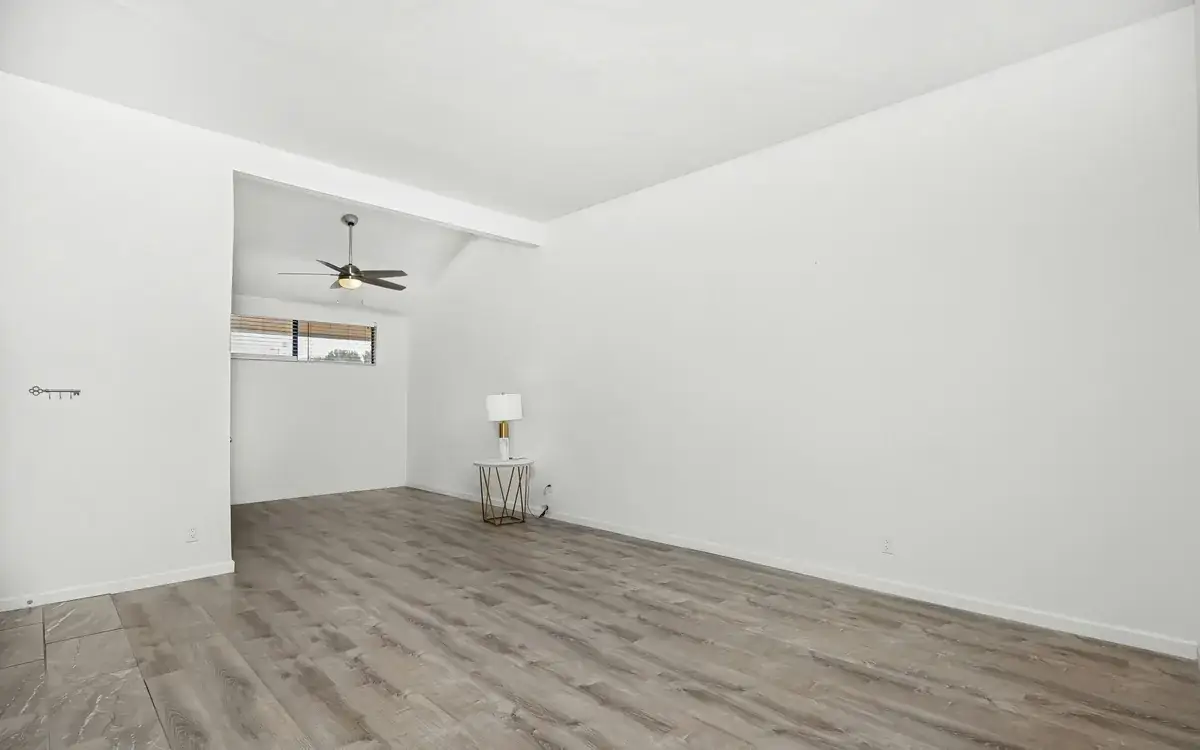
Waterproof SPC and WPC plank installed over prepared slab, with moisture testing and flatness correction handled before the first plank goes down.
A waterproof core is the reason this product dominates Fort Bend homes
Learn more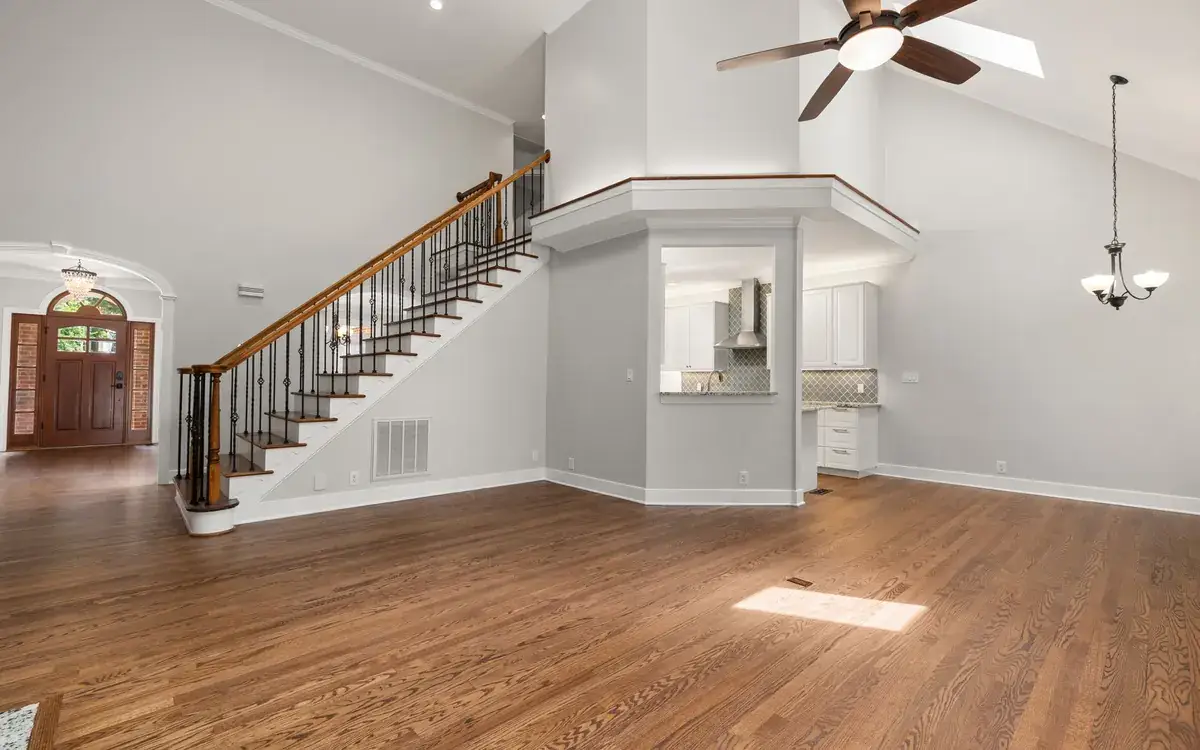
Hardwood Floor Installation
Solid and engineered hardwood installed to NWFA guidelines, with slab moisture testing and a documented acclimation period before any board is fastened.
Gulf Coast ambient humidity is the governing variable here. The NWFA target interior range of 60-80F and 30-50% relative humidity is difficult to hold in a Fort Bend home that is not conditioned during construction
Learn more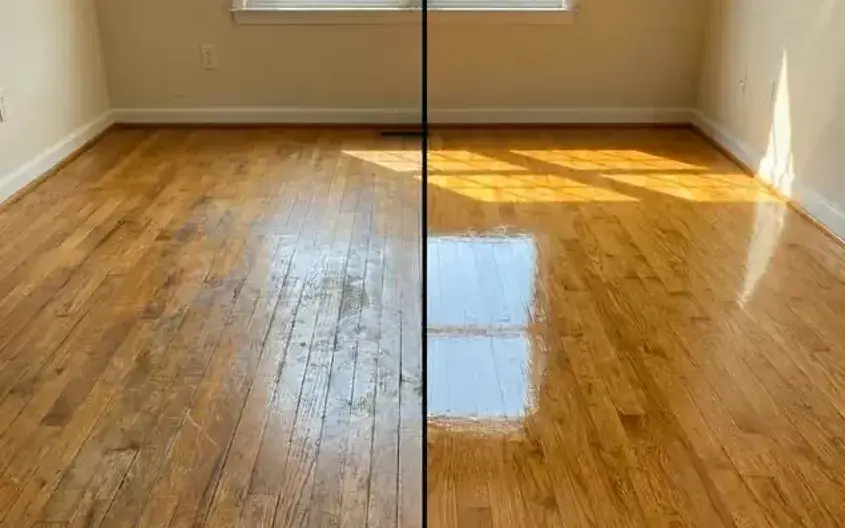
Hardwood Floor Refinishing
Dustless sanding and refinishing with HEPA containment, a full grit progression, and a finish system chosen for cure time and household traffic.
Cure time is the local trap. Full cure in high ambient humidity runs at the long end of the published window, and putting rugs down early is the most common way a good refinish gets ruined here
Learn more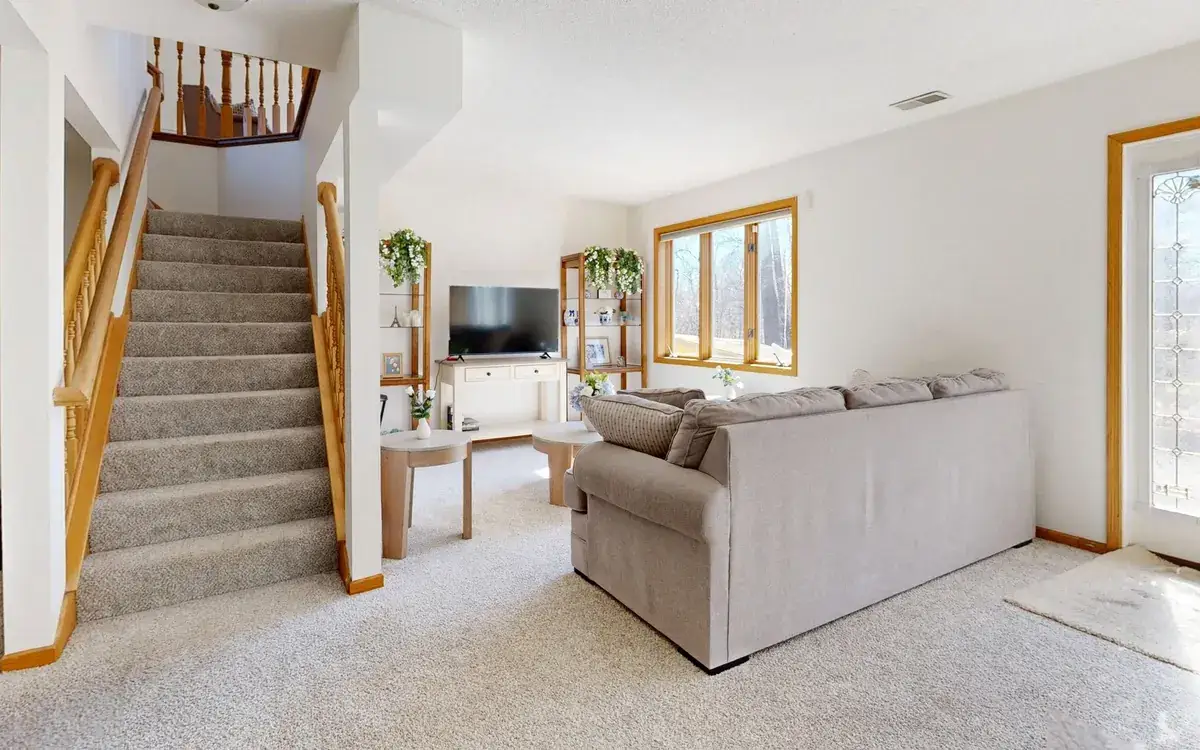
Carpet Installation
Fiber and pad selected for the room, power-stretched to spec, with old carpet removed and hauled away.
A moisture-barrier pad is worth the upgrade on a Fort Bend slab, because vapor drive from below is what turns an ordinary spill into a persistent odor problem
Learn more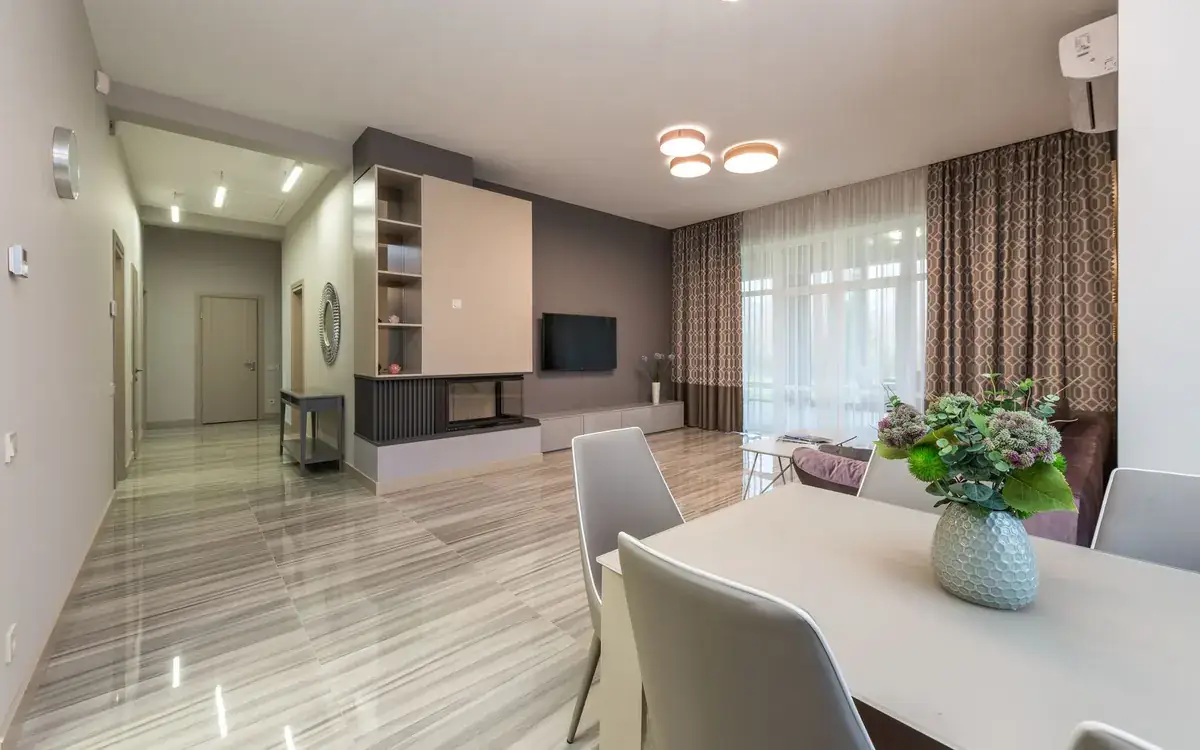
Tile and Stone Flooring Installation
Porcelain, ceramic and natural stone set to TCNA substrate and movement-joint standards, with lippage and slab movement addressed up front.
Expansive clay is why tile cracks in Fort Bend. Slab movement telegraphs straight through a rigid assembly unless a crack-isolation or uncoupling membrane breaks the bond
Learn more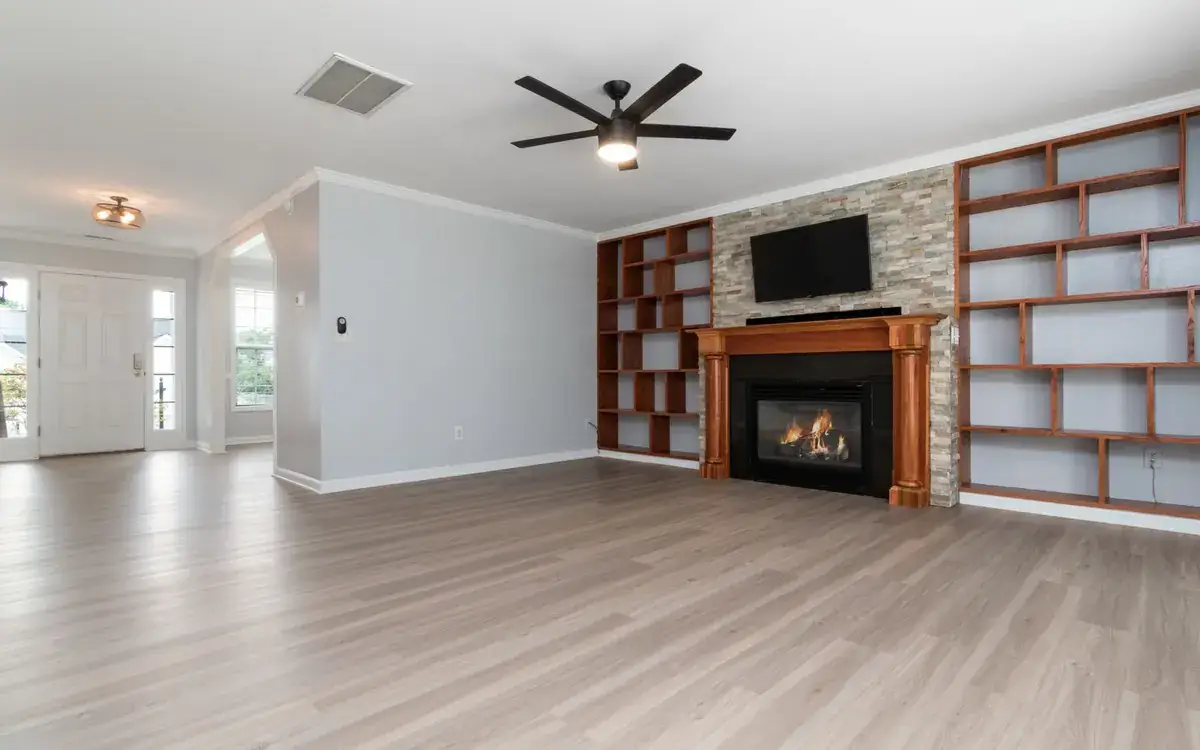
Laminate Flooring Installation
Click-lock laminate over a moisture-managed subfloor, with AC rating matched to actual household traffic rather than to shelf price.
Laminate has an HDF core, which means water is still its failure mode. In a Fort Bend kitchen or bath, waterproof vinyl plank is usually the more honest recommendation even though laminate costs less
Learn more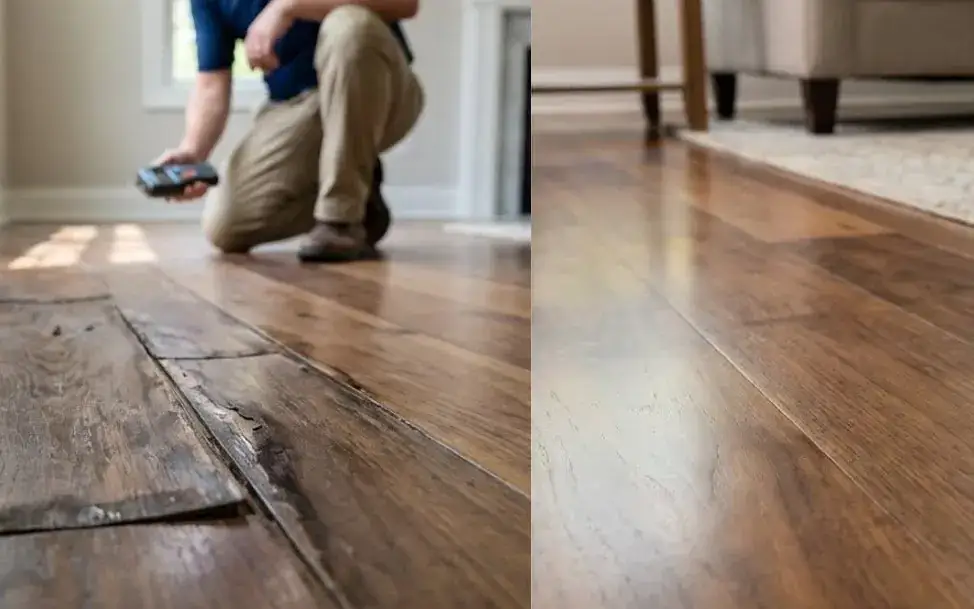
Floor Repair and Water Damage Restoration
Board replacement, subfloor reinforcement and color-matched repair after leaks, flooding and settlement — spot repair where spot repair is honest.
The Brazos runs through Richmond and Rosenberg, and 2016, Harvey in 2017 and Imelda in 2019 each produced a wave of flooring replacement across Fort Bend. Flood repair is a standing local need here, not an edge case
Learn more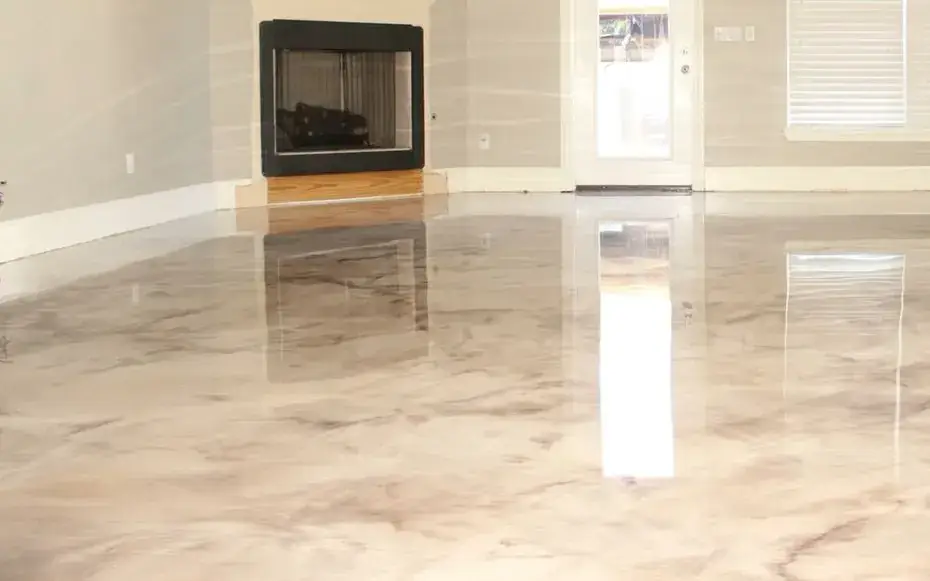
Epoxy and Concrete Floor Coatings
Mechanically profiled, moisture-tested epoxy and polished concrete for garages, warehouses and commercial floors along the US-90A corridor.
Epoxy delamination in Texas garages is almost always a moisture or profile failure, not a product failure. ASTM F2170 testing before the primer goes down is what separates a coating that lasts from one that peels in a summer
Learn more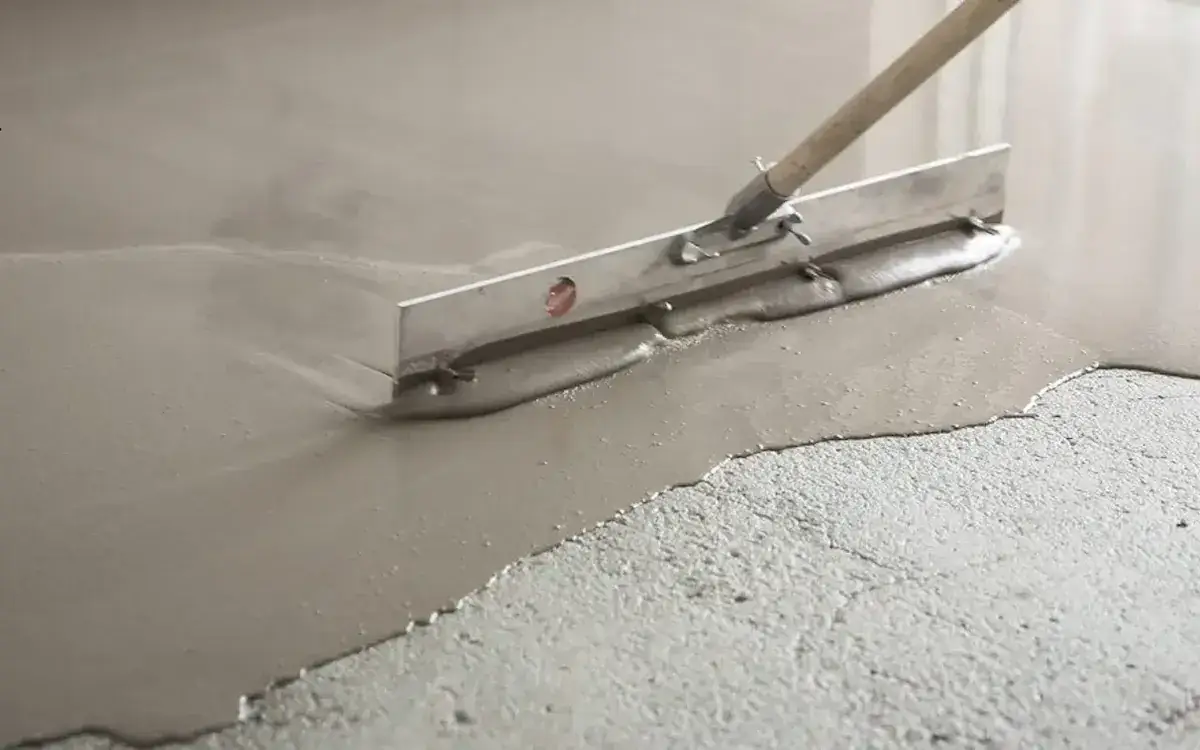
Subfloor Preparation and Slab Leveling
The work under every other service on this site: ASTM moisture testing, flatness correction and vapor mitigation before a finish floor is committed to.
This is the page most flooring companies in this market do not have. Competitors sell material; almost none explain what a slab has to prove before it earns a finish floor
Learn moreThe part nobody shows you
The slab decides, so we start there
Beaumont Formation clay runs under most of Fort Bend County, and it swells and shrinks with the seasons. Slabs riding on it move. A floor that was flat when the house went up in 1994 is frequently out of tolerance today.
Concrete here also passes moisture upward year round. That vapour is what breaks adhesive bonds, cups hardwood and lifts epoxy off a garage floor. It is invisible without a proper test, and a plastic sheet taped down overnight is not one.
So before we quote, we measure flatness and read the slab. Sometimes that means telling you the concrete is not ready. Waiting is cheaper than installing twice.
Pricing
What actually moves the price
We do not quote over the phone. An estimate written without a moisture reading is a guess that gets corrected halfway through the job — usually upward. Here is what we are looking at when we measure.
Slab condition
Flatness and moisture decide whether preparation is a morning of grinding or a full levelling pour. This is the largest swing on most quotes.
Tear-out
What is coming up, and what is bonded underneath it. Glued-down carpet and thinset tile are not the same job as a floating floor.
Material
Matters less than most people expect. Two floors at the same price per square foot can carry very different preparation costs beneath them.
Want the ranges before you call? Our cost guides break down what each material runs in this market, hedged and sourced — start with flooring installation cost in Rosenberg .
Questions we are asked most
Start here
What areas of Fort Bend County do you cover?
Rosenberg and Richmond are our home ground, and we work across Fort Bend County including Sugar Land, Katy, Missouri City, Fulshear, Stafford, Sienna, Cinco Ranch and Pecan Grove, plus Brookshire, Sealy and Wallis to the west. If you are unsure whether you are inside the radius, call and ask.
What does flooring cost in Rosenberg?
It depends far more on your slab than on the material. Published industry ranges for residential flooring run roughly $3 to $18 per square foot installed, but where a specific project lands inside that depends on flatness, moisture readings, tear-out and what turns up underneath. We measure before quoting rather than pricing over the phone.
Why do you test the slab before quoting?
Because in Fort Bend County the slab is usually the variable that decides whether a floor lasts. Expansive Beaumont clay moves slabs seasonally, and concrete here passes moisture upward year round. An ASTM F2170 relative humidity reading and a flatness measurement tell us what the floor is actually going onto.
How soon can you start?
Scheduling depends on the current workload and on whether your slab needs testing first, since an in-situ moisture probe has to equilibrate before it reads accurately. Call and we will tell you honestly where you would fall in the queue rather than promising a date we cannot hold.
About the work
Is vinyl plank suitable for kitchens and bathrooms?
Yes. SPC and WPC cores are waterproof through their full thickness, so they will not swell the way an HDF-core laminate does after a dishwasher leak or an overflowing tub. The plank itself is not the weak point in a wet room; the perimeter detail and the transitions are, which is why those get sealed properly.
Is glue-down or click-lock vinyl plank better?
Click-lock floats over the slab and tolerates small seasonal movement, which suits most Fort Bend homes. Glue-down resists rolling loads and heavy furniture better and is the usual choice for commercial floors. The deciding factor is normally slab flatness and how the room gets used, not price.
Can engineered wood flooring be installed over concrete?
Yes, using an approved glue-down or floating method. The slab has to be evaluated first for moisture, flatness, cracks, surface contamination and any old coatings or adhesive. On a Fort Bend slab the moisture reading is the gate: if the concrete is above the manufacturer's limit, installation waits or a vapor mitigation system goes in.
Why is acclimation important before installing hardwood?
Wood moves with the moisture in the air around it. Boards delivered from a climate-controlled warehouse into an unconditioned Gulf Coast house will take on moisture and expand after installation, which shows up as cupping and buckling. Acclimation of 48 to 120 hours lets the wood reach equilibrium with the room it will live in.
How do I know if my floors need refinishing?
Water no longer beads on the surface, traffic lanes have gone dull and gray, and scratches reach through the finish into bare wood. A quick test: put a few drops of water on a worn area. If it soaks in within a minute rather than sitting on top, the protective finish is gone and the wood is taking the wear.
Can every hardwood floor be sanded and refinished?
No. Solid hardwood can usually take three to seven sandings over its life. Engineered flooring depends entirely on wear layer thickness, and anything under about 3mm has little or nothing left to remove. We measure the wear layer at a threshold or vent before quoting rather than finding out mid-sand.
What is carpet padding and why does it matter?
The pad is the cushion between carpet and subfloor, and it does most of the work in how a floor feels and how long it lasts. Too soft and the carpet backing flexes and breaks down early. On a Fort Bend slab a moisture-barrier pad also stops vapor from below reaching the carpet backing.
What carpet is best for high-traffic areas?
Loop and low-profile cut-loop constructions in nylon or triexta hold up best where traffic concentrates. Deep, soft cut piles feel wonderful in a bedroom and crush quickly in a hallway. Fiber type and pile height together decide wear performance, and density matters more than the marketing terms on the sample.
Why does tile crack in Fort Bend homes?
Almost always because the slab moved and the tile was bonded rigidly to it. Expansive clay under this county swells and shrinks seasonally, and that movement transmits straight through thin-set into the tile. A crack-isolation or uncoupling membrane breaks that bond so the slab can move without taking the floor with it.
What is the difference between marble, slate and granite?
Granite is the hardest and least porous, which makes it the most forgiving underfoot. Marble is softer, etches with acids and needs regular sealing. Slate is dense and naturally slip-resistant but cleaves in layers and varies in thickness. Porosity and hardness, more than appearance, should drive the choice for a floor.
What is a floating floor installation?
The planks lock to each other rather than being fastened or glued to the subfloor, so the whole field floats as one panel over an underlayment. It installs quickly, can go over many existing hard surfaces, and can be lifted later. It also requires an expansion gap at every wall and fixed object.
Can laminate be installed over existing flooring?
Often yes, over sound tile, vinyl or wood that is flat, well bonded and dry. It cannot go over carpet, and it should not go over anything hiding a moisture problem. Adding a floating floor on top raises the height at every threshold and door, which we account for before starting.
When can a damaged floor be repaired instead of replaced?
When the damage is localized, the surrounding material is sound, and matching stock is obtainable. Water damage confined to one room usually qualifies. Damage across multiple rooms, or a floor whose wear layer is spent, generally does not. Targeted repair can save up to 60 percent against full replacement when it genuinely applies.
How closely can a repaired section match the existing floor?
On a floor that will be sanded and refinished afterward, very closely, because the whole surface ends up with one finish. On a floor being spot-repaired without refinishing, expect a visible difference: the surrounding boards have aged and the new ones have not. We show you a sample before committing.
Does concrete need preparation before epoxy?
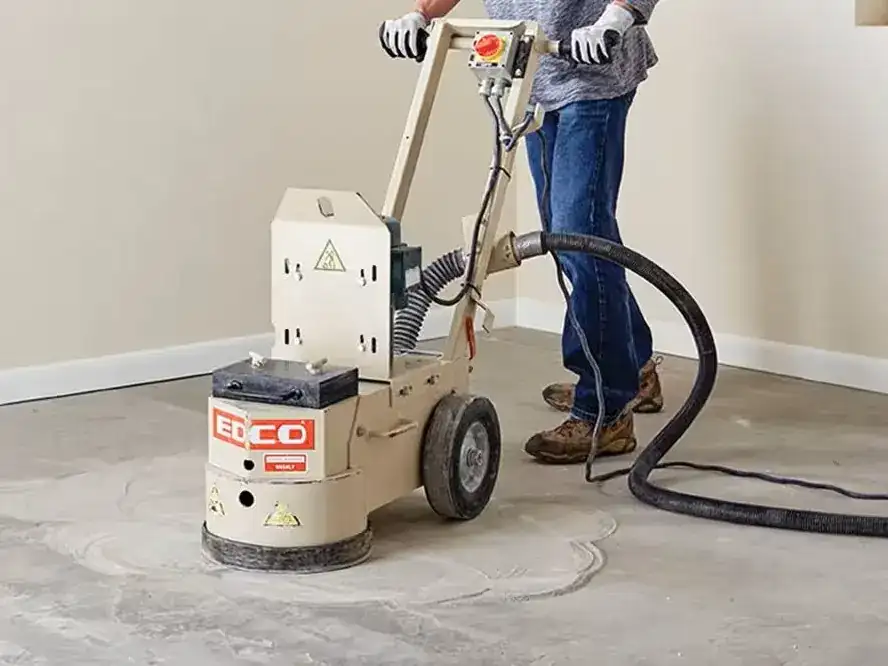
Yes, and this is where most failed epoxy floors were lost. The slab needs mechanical profiling by diamond grinding or shot blast to open the surface so the coating can key into it. Acid etching alone does not produce a reliable profile on a Gulf Coast slab that has absorbed years of humidity.
What is the difference between a DIY epoxy kit and a professional installation?
Solids content and preparation. Retail kits are typically thin, water-thinned coatings applied over an etched surface, and they peel. A professional system uses high-solids or 100 percent solids epoxy over a mechanically profiled, moisture-tested slab, applied in primer, base and topcoat layers with controlled cure.
What causes floors to become uneven, and how is it fixed?
On a Fort Bend slab, usually seasonal clay movement, original construction tolerance, or settlement. On wood subfloors it is joist deflection or moisture damage. The fix is measurement first, then self-leveling compound, patching or structural reinforcement depending on whether the cause is surface or structural.
Do you level uneven concrete floors?
Yes. Self-leveling compound is poured over a primed slab and finds its own level, walkable in two to four hours and ready for finish flooring after full cure. Deep or sloping areas may need building up in lifts. We measure the deviation across the room before quoting so the material volume is real.
Materials, cost and climate
Can solid hardwood be installed over a concrete slab?
Only by building a wood subfloor over the slab first, since solid plank needs something to fasten into and post-tension concrete cannot be drilled. That adds height at every threshold and door, plus cost. Over slab-on-grade, engineered hardwood installed directly is the more common and more practical answer.
What does cupping in a hardwood floor mean?
The edges of each board sit higher than its center, giving the floor a washboard feel underfoot. It means the underside of the wood is wetter than the top, so the bottom has swollen more. The moisture source is almost always below: slab vapor, a crawlspace, or a leak.
What is the actual difference between vinyl plank and laminate?
The core. Laminate is built on a high-density fiberboard core, which is a wood product that swells permanently when wet. Vinyl plank is built on an SPC or WPC core that does not absorb water. Everything else about the two products, including how they look, is secondary to that.
How long should a flooded floor dry before new flooring goes down?
There is no calendar answer, only a meter answer. Concrete and wood release moisture at rates that depend on materials, containment, equipment and weather. The correct standard is documented readings against the new flooring manufacturer's published limit, not a fixed number of days.
Why is one refinishing quote half the price of another?
Usually coat count and grit passes. A two-coat job over a partial sand costs far less than a full three-pass sand with three coats, and both get described as refinishing. Ask each bidder how many sanding passes and how many finish coats are in their number.
Who actually installs flooring bought from a national retailer?
Usually an independent subcontractor working under a contract with the retailer, not a retailer employee. That is a normal industry arrangement rather than a scandal. It matters because it determines who you call when something goes wrong and who is responsible for fixing it.
Does new flooring increase a home's value?
It affects saleability more reliably than appraised value. Flooring is the first thing a buyer sees and the easiest thing for them to price as a deduction. Worn carpet invites a lowball offer sized to a whole-house replacement, which is usually more than the actual work would have cost.
Is click-lock vinyl plank genuinely a DIY project?
Yes, in the right conditions. A flat, dry, sound slab in a simple rectangular room with straightforward transitions is well within reach of a competent DIYer with a weekend and a good utility knife. The product is designed for it. What defeats DIY installs is almost never the plank itself.
What does flooring installation cost per square foot in Rosenberg?
Industry-observed ranges for residential flooring run roughly $3 to $18 per square foot installed, depending on material, complexity and preparation. Commercial systems run $3 to $16. Those are market ranges rather than a quote, and where a specific project falls inside them depends heavily on what the slab needs.
How long does a whole-house flooring installation take?
For vinyl plank in a typical single-story Fort Bend home, one to three days once material is on site. Hardwood runs three to seven days including acclimation. Tile runs two to five days. Add a day plus cure if the slab needs leveling compound, which is common on older slabs here.
What is the single most important question to ask?
What did you measure, and what did you find. A contractor who has measured slab flatness and tested moisture can tell you numbers. One who quoted from square footage cannot. That single answer separates a fixed price from a price that will change once the old floor comes up.
What is the difference between SPC and WPC?
SPC has a stone-plastic composite core: denser, stiffer, better at bridging small slab imperfections and more dent-resistant under heavy furniture. WPC has a wood-plastic composite core: softer, warmer and quieter underfoot, but it telegraphs subfloor irregularity more readily and dents more easily.
How hard is it to use a rented drum sander?
The machine is not hard to operate. It is hard to operate without leaving marks. A drum sander cuts aggressively and will dig a dish into the floor if it pauses while running. The skill is entirely in constant motion and consistent lowering and lifting, and it is learned by ruining floors.
What is the most scratch-resistant flooring for dogs?
Porcelain tile, by a wide margin, though it is hard and cold underfoot. Among resilient options, a vinyl plank with a 20 mil or thicker wear layer and a ceramic-bead or urethane surface treatment performs well. Laminate's wear surface is often harder than vinyl's, but its core cannot handle accidents.
What is ASTM F2170?
The standard method for measuring relative humidity inside a concrete slab. Probes are drilled to a specified depth, sealed, and left to equilibrate before reading. The result describes the moisture condition within the slab rather than at its surface, which is what flooring manufacturers write their limits against.
What is the best flooring for a kitchen on a concrete slab?
For most Fort Bend kitchens it is either rigid-core vinyl plank or porcelain tile. Both handle slab vapor without complaint, both survive a dishwasher leak, and both go down over concrete without the subfloor build-up that wood needs. The choice between them comes down to comfort underfoot and how much you mind a dropped glass surviving or not.
Is carpet priced by the square yard or the square foot?
Both, which is the single biggest source of confusion in carpet pricing. Mills and many retailers still quote by the square yard, while flooring quotes for every other material are written per square foot. A square yard is nine square feet, so a carpet quoted at $27 per square yard is $3 per square foot. If one bid looks three times another, check the unit before anything else.
Why is a professional epoxy floor so much more than a kit from the store?
Because almost none of the cost is the epoxy. A professional job is priced around mechanical preparation: diamond grinding or shot blasting the slab to open its pores so the coating can bond. A roll-on kit skips that and relies on an acid etch or on nothing, which is why kit floors commonly peel within a couple of years and why removing a failed coating costs more than the original job.
Why does hardwood cost more to install on a slab than upstairs?
Because a slab cannot be nailed into. Upstairs, over a plywood subfloor, boards are nailed or stapled down and the job moves quickly. On slab-on-grade the floor has to be glued down, floated, or installed over a plywood subfloor fastened to the concrete first. Each of those is a different amount of material and labor, and the choice is usually made for you by the product and the moisture reading.
Why is laminate cheaper than vinyl plank to buy but similar to install?
Because the labor is nearly the same job. Both are click-lock floating floors that need a flat, dry substrate, expansion gaps at every wall and transitions at every doorway. The installer does not care much which one is in the box. The material price gap is real, the labor gap is small, and that is why the percentage saving on the total is smaller than the shelf prices suggest.
Can you refinish hardwood floors yourself?
Yes, on a solid floor with enough wear layer left, in a simply shaped room, if you accept that the first few square feet are where you learn. The two things that end DIY attempts are a drum sander dwelling in one spot and gouging, and discovering mid-job that the floor is engineered with a wear layer too thin to sand. Check the second before renting anything.
What is the labor cost to install vinyl plank flooring per square foot?
Labor is commonly quoted separately from material and, in published industry pricing, sits in the region of $1.50 to $4.50 per square foot for click-lock installation over a prepared substrate. Glue-down runs higher because of adhesive and the tighter flatness tolerance it demands. Slab preparation is not included in that figure and is the line most likely to move it.
Why does large format tile cost more per square foot to install?
Because a big tile cannot bend to follow a slab. The larger the tile, the flatter the substrate has to be, and industry standards call for a tighter flatness tolerance as tile size increases. Meeting that usually means leveling work, and large tiles are also heavier to handle, need back-buttering and leave less room to correct as you go.
Is repairing a hardwood floor cheaper than replacing it?
When the damage is localized and matching stock is obtainable, usually by a wide margin. The calculation changes once the affected area passes roughly a quarter of the room, because at that point the labor of weaving in new boards and blending the finish starts to approach the cost of simply refinishing the whole floor, and a full refinish gives a better result.
Ready for floors that stay flat?
We will measure the space, test the slab, and hand you an estimate that separates material, labour, tear-out and subfloor preparation — so you can see what each part of the job actually costs.